Know Your Heart
Updated 8 April 2026 to include more space health facts.
Do you have a heart?
Yes you do!
It pumps blood!
Let's get to know your heart today!
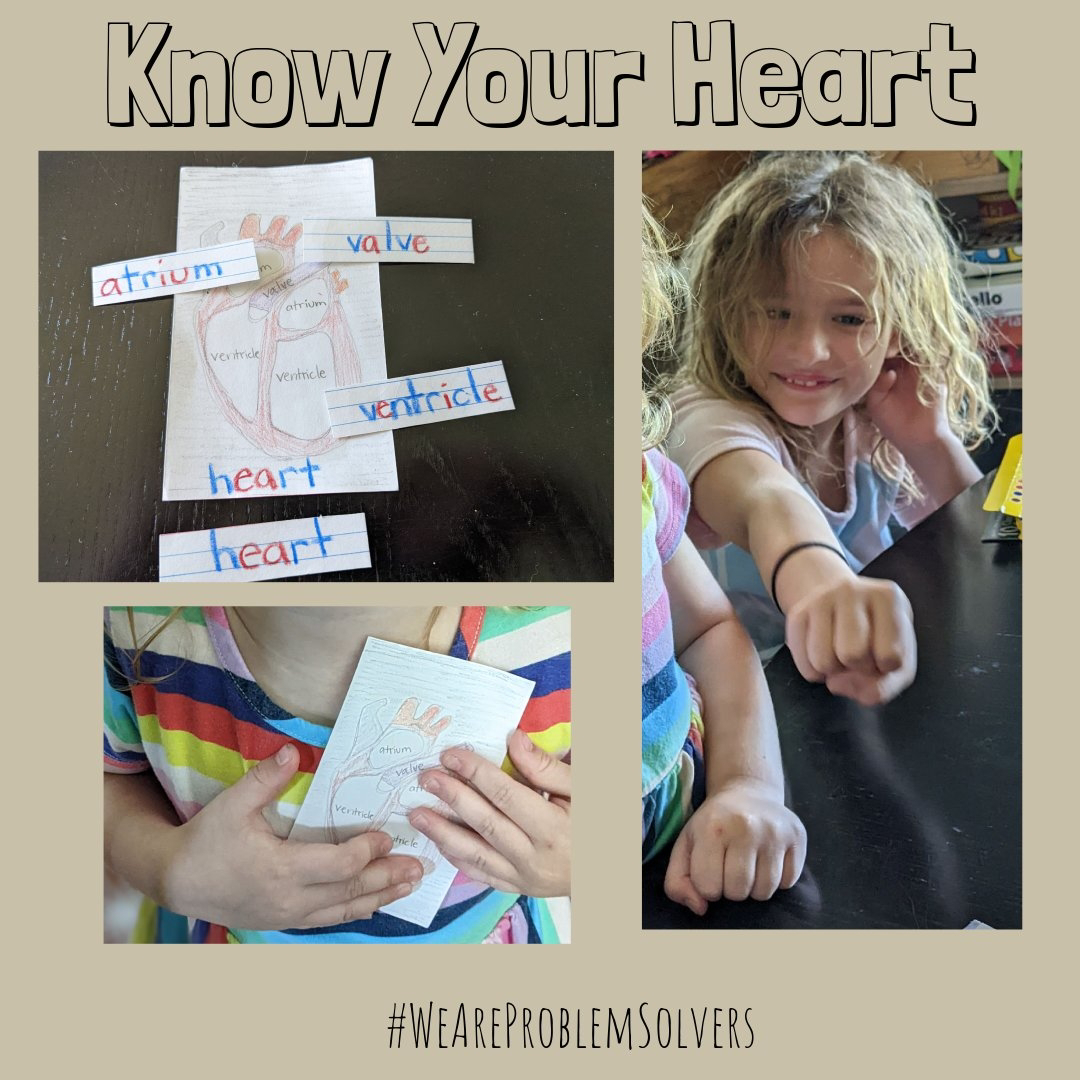
Here is an image of the words "know your heart" with a few photo highlights from this lesson.
Where is your heart?
In your chest!
How big do you think it is?
It's as big as a fist. Show me your heart fist! Very good, here's a picture of two children showing me the size of their hearts.

Here let's hold this picture of a heart to your heart.
Here's a picture of a toddler holding a picture of a heart to her chest.

What sound does your heart make?
Pump-thump. Pump-thump. Pump-thump.
Can you find your pulse?
"What's a pulse, Ma?"
It's a spot where you can feel your heart beating.
For kids it is often easiest to find a pulse in the neck.
Here's a photo of a 6 year old finding her pulse.

Blood
Valve
Pump
Vessels
Can you color them? It's ok if you need to scribble. Whatever is most fun for you.
Here's a photo of a word that has been colored on by a toddler and an older child.

Can you match some of these little words to the picture? Here's a picture of things matched up!

Can you match some of the little words to the big words?
Help me find Valve.
Oh no, which says pump?
I can't find blood. Can you?
What's this last word? Oh, that's right: vessels.
Here is a picture of little words matched with big words. Let's sound them out and read them together!

Which one of these words ends with an S?
Which one of these words starts with a B?
Which one of these words starts with a P?
Which words start with V?
Great looking!
Here's a picture of all of our materials that we used for this little lesson today.

Additional Materials
Did you notice the book on the table? We referenced this book from the Encyclopedia Britannica interactive book series.

Here is a link to a video about the heart:
Here is a link to a video about the circulatory system, which puts the heart in the context of the whole system that it supports: https://youtu.be/f9ONXd_-anM
Our Heart in Space
What happens with Astronauts' hearts in space? Oh my! What an interesting question.
Did you know? In space the heart changes shape! It shifts from ovoid shape to a round sphere. Here's a picture that compares heart shapes.

If you spend enough time in space, the muscles that usually work to constrict blood vessels weaken. The special word for that is atrophy. This changes how blood flows.
Astronauts need to do a lot of exercise in space to take care of their hearts. Here's a photo of an astronaut using the CEVIS, a bicycle for space.

When they visit the International Space Station, Astronauts monitor their heart health with a special ultrasound machine. Here's a photo of a Canadian astronaut using the device.

Did you know? On 4/7/2026 the astronauts on the ISS used the ultrasound machine to check for blood clots in their neck, on the same day that they were able to schedule a call with the astronauts on the Artemis II mission! Would you like to listen to the call between ISS Astronauts and Artemis II Integrity astronauts? Here's a link to the recording on YouTube. https://www.youtube.com/live/MQ1djhczoFI?si=qTPSCCHFcwRsQzh6
Artemis II Lunar Flyby Mission and Human Health

The Artemis II astronauts are flying around the moon and back. They're currently participating in a suite of human health studies designed to monitor their vitals and physiological changes during their 10-day mission around the Moon. As they travel through deep space, the crew acts as both test subjects and scientists, tracking how microgravity and higher radiation levels impact the human body.

Core Health Monitoring and Vitals
Standard Measures Study: The crew is part of NASA's Spaceflight Standard Measures program, which collects heart rate, blood pressure, and core temperature data to compare pre-, in-, and post-flight health.
Wearable Technology: Crew members wear specialized wristbands and ARCHER sensors to continuously monitor sleep patterns, movement, and stress levels.
Immunology Tracking: Each morning, astronauts provide dry saliva samples using paper strips to track stress hormones (cortisol), viruses, and immune system markers, as liquid storage is limited on the Orion spacecraft.

Physiological and Behavioral Assessments
Cardiovascular Health: Researchers are analyzing fluid shifts toward the head, which can cause facial puffiness and increased intracranial pressure.
Motion Sickness & Balance: The crew self-reports symptoms of space motion sickness and will undergo intensive balance and vestibular testing immediately upon return to investigate post-flight dizziness.
Vision Testing: Astronauts perform in-flight vision tests and eye imaging to monitor for Spaceflight Associated Neuro-ocular Syndrome (SANS), though the risk is lower on this short 10-day mission compared to long-term ISS stays.
Team Dynamics: The ARCHeR study specifically evaluates how the deep space environment affects the crew's alertness, cognition, and ability to work together under high-demand tasks.
The mission is currently scheduled to conclude with a splashdown in the Pacific Ocean on April 10, 2026, after which the crew will immediately begin a battery of post-flight physical tests, including simulated moonwalk activities.

Comments
Post a Comment